The Wonders of Wool Why Wool is my Choice for Rug Punching.
When I first started designing wool rugs, I was definitely a novice when it came to hooking or punching a rug. I first learned the craft when I attended a weekend wool hooking workshop. I had no idea what to expect. One day I told Steve I was heading to Louisiana to learn how to make a rug. He sort of looked at me and said, “Ok…have fun…I’m going fishing.” So off we go in our separate ways and for myself…a little nervous but excited.
I imagine I looked pretty silly to the seasoned ‘hookers’ who joined their friends for the weekend. I knew I was in trouble when I was pushed aside by women pulling wagons full of wool, frames, and tools to grab the best table in the room to set up shop for the long hours ahead. I found an empty chair, put down my small bag of wool applique ( I didn’t want to come empty handed) and waited thinking there would be some sort of introduction when all the other ladies walked around hugging each other and showing off their latest projects. Well, needless to say, I had a lot to learn. And learn I did. These ladies put me under their wings and when I went home on Sunday I had an Oxford Punch Needle in my bag, a pattern, and some wool. I was in heaven and my rug making journey had begun.
What I’ve Learned about Wool
Learning rug punching is an everyday occurrence, and new hints and tricks are constantly being added to my arsenal. One thing I have learned over the years is the importance of using high-quality tools, foundation fabrics, and wool to create strong, beautiful pieces that will stand the test of time.
Many will disagree, insisting that acrylic yarn is just fine—and much cheaper than wool. And that is true. Acrylic yarn is less expensive. But be careful if you plan to walk on a rug made with acrylic yarn. Wool is naturally resilient and better suited for a rug that will actually be used underfoot.
Chunky wool yarn isn't always easy to find and is most often available through specialty shops or online.
Rug punching or hooking is not an inexpensive craft. It takes hours to complete a rug, pillow, or wall hanging, so why wouldn't you want to use textiles that will endure over time?
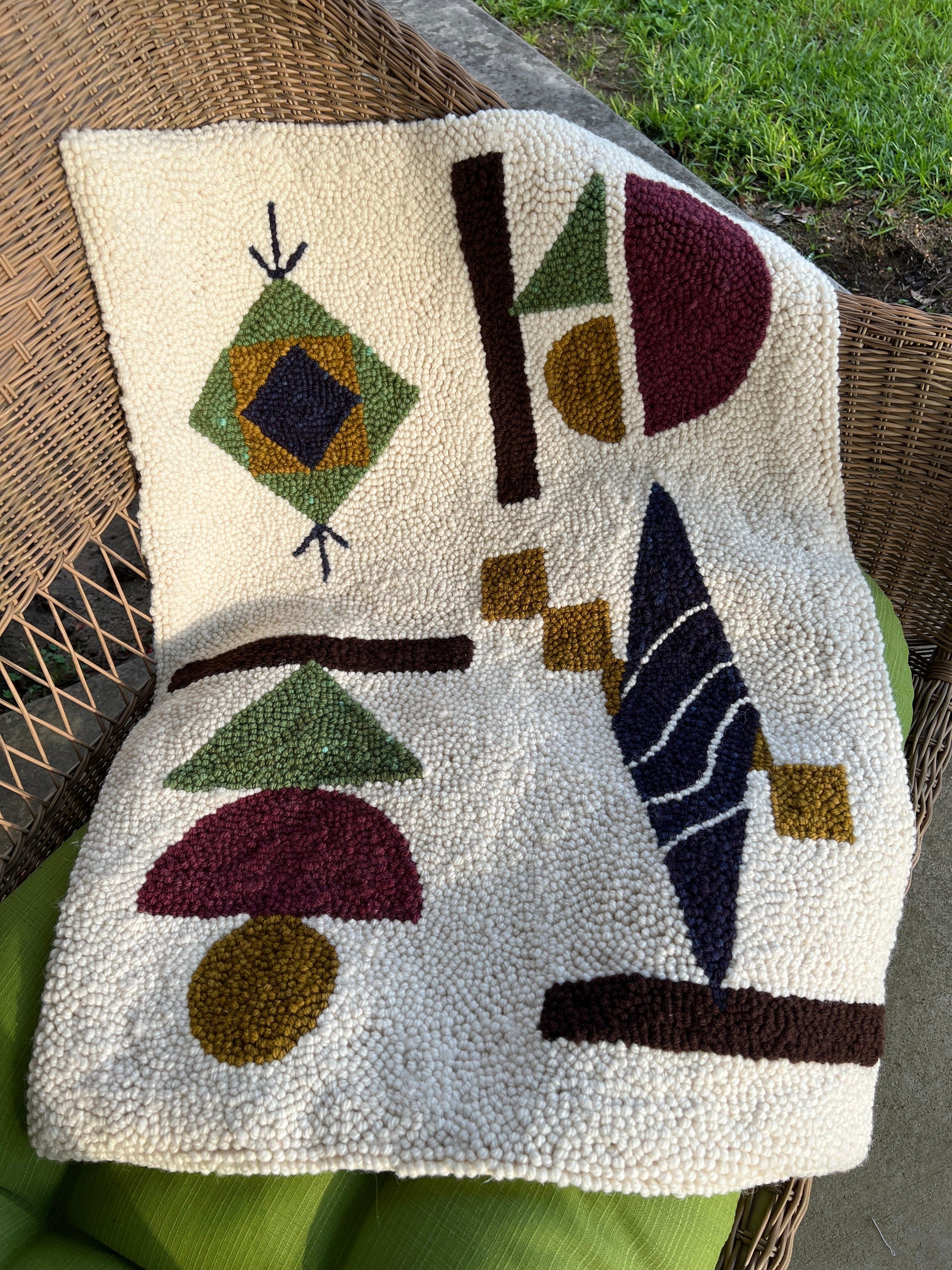
Below you will find one of my geometric designs, Bohemian Bliss. I offer the pattern for those who would like to make their own, as well as the completed rug, ready to use and enjoy.
What Kind of Wool Yarn is best for Rug Punching?
When it comes to rug punching, I choose 100% wool whenever possible. There’s something about wool that feels right to me. I love the way it feels in my hands, the way it looks in my finished piece, and the way it holds up over time. I feel rugs are to be used, not simply admired, just like quilts. So I want to know that the hours I spend punching a rug, I will end up with something that will last a very long time.
I've tried other yarns, including acrylic and some very soft wool yarns. They may be beautiful, but I've learned that beautiful yarn doesn't necessarily make good rug yarn. I once used a very soft wool yarn from Joann, and although there was nothing wrong with the yarn itself, the finished piece simply didn't have the substantial feel I wanted in a rug. Now, that’s not to say these yarns are bad. I have used them for pillows and wall hangings. Pillows should be soft so when you are lying on the couch watching television, the pillow molds around your head and feels blissful. So there is a time for soft wools and acrylic fibers. Just not for rugs that are going to be well used.
Wool behaves differently, as well. When I am punching through monk's cloth the wool fibers have a natural fullness and spring to them. The fibers help fill the spaces and create that dense, substantial feel I associate with a hand-punched rug. Acrylic just doesn’t behave the same way. And most importantly, one of the of most important finishing processes of rug punching is to set your piece with heat or steam. Acrylic yarn cannot be set this way because synthetic fibers can melt or be damaged by heat.
Maybe part of my love for wool is simply the history of it and my faith that has been instilled in me by my ancestors. Wool has been worked by human hands for thousands of years, and we see it throughout Scripture. Proverbs 31:13 says, “She seeketh wool, and flax, and worketh willingly with her hands.” I love that verse. It comforts me when I am working with wool, through rug making and wool applique quilting. Working with the same natural fiber that women have spun, woven, and fashioned into useful things for generations calms me. My tools may be different, but the simple act of creating something useful and beautiful with wool and my own two hands connects me to a very long tradition.
The Five Benefits of Using Wool
Wool has been a staple textile for thousands of years, prized for its durability, warmth, and versatility. Today, wool rugs continue to be popular for their luxurious feel, timeless beauty, and exceptional performance. I have listed five points that I’ve learned about wool and why I continue to justify the use of wool on handmade rugs.
Durability: Wool fibers are naturally resilient, resisting wear and tear even under heavy foot traffic. Unlike synthetic materials that can pill or fray over time, wool rugs maintain their shape and appearance for years to come. We use our rugs. If I am going to spend the time punching them I want to enjoy them.
Insulation: Wool is a natural insulator, providing warmth in the winter and coolness in the summer. This makes wool rugs ideal for any climate, ensuring your feet stay comfortable throughout the year. We live in Florida. We have several of our rugs on the floor of our RV. We love the feel of them on cold nights and hot summer days. They are the best.
Resilience: Wool rugs are incredibly resilient, able to bounce back from dents and creases. If your rug gets wrinkled or flattened, simply give it a good shake or vacuuming, and it will quickly return to its original shape. Just shake it off, and it comes back to life. Now I don’t use the vacuum on it. It could grab the threads so I do protect them from the vacuum cleaner.
Sustainability: Wool is a natural, renewable fiber. Sheep are shorn as part of their regular care, providing a fiber that can be used again and again as the fleece regrows. Wool is also biodegradable under the right conditions, meaning it decomposes naturally over time, reducing its environmental impact. By choosing wool rugs, you're supporting sustainable farming practices and minimizing your carbon footprint. Click the link and you can read all about sustainability. We do make sure that the mills we purchase from farmers that take care of their animals.
Beauty and Variety: Wool yarn comes in a wide range of colors, textures, and patterns, allowing you to create truly unique and personalized rugs. And if you can’t find it in the stores, get out the dye pan and have fun.
Come See Us at the New Jersey Sheep & Fiber Festival
And speaking of wool and sheep...
If you're going to be at the New Jersey Sheep & Fiber Festival September 12 and 13, be sure to look for Magnolia's Soul & Spice! Barbara and Doug will be there with the food trailer, serving up some of their Southern and Cajun favorites while everyone enjoys a weekend filled with sheep, fiber, makers, and all the things we love about this wonderful community.
Goldenrod and Magnolia's may seem like two very different worlds, but around here they're both family businesses—and somehow wool and good food seem to go together just fine!
If you’re planning to join us for the weekend, click the link above for more information about the festival and tickets. We hope to see you there!